Compostable Utensils Individually Wrapped: Where the Claim Breaks
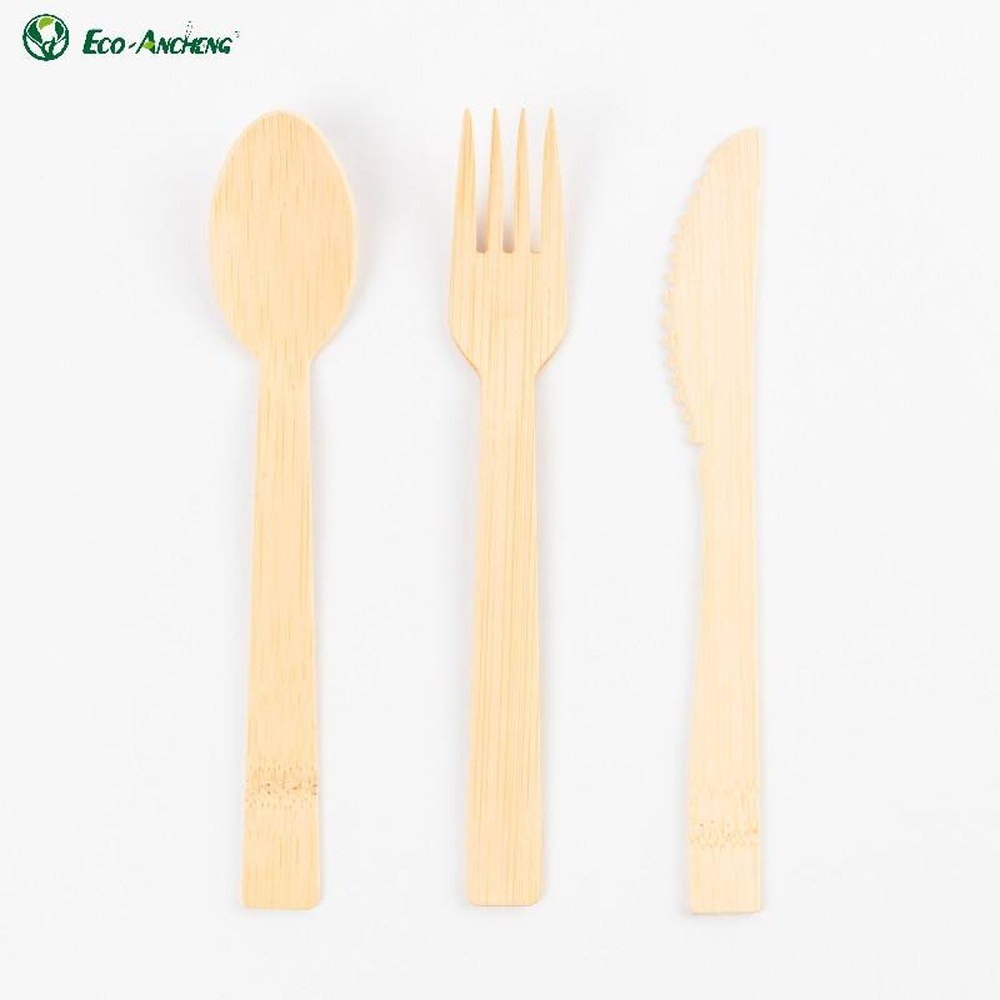
Last March a catering buyer in Sydney sent back a sample box. Her bagasse fork was certified OK Compost HOME, the spoon carried a BPI number, and each piece sat inside a printed film sleeve her marketing team had designed. Her composter opened one sleeve, read the resin code, and refused the whole load. The cutlery was fine. The wrap was not — and the wrap was the only thing the facility could see.
Individually wrapped cutlery is bought for hygiene and counter speed. It is certified as a kit, and that claim survives only if every layer inside the sleeve passes the same test. We run bagasse and paper cutlery in Qingdao at 2,500–3,000 tonnes a year; about a fifth of our utensil volume ships wrapped.
Why wrapping turns a good fork into landfill
An unwrapped bagasse fork enters an organics bin as one object. A wrapped fork enters as a composite: fibre, seal layer, printing ink, sometimes an adhesive sticker. Plants in the Netherlands, Belgium and California sort mechanically before the tunnel. Film sleeves at 20–30 µm read as plastic on near-infrared sensors. Out they go, with the fork.
Delivery platforms made this worse. Wrapped kits arrived as a hygiene promise — “sealed, never touched” — and buyers ordered them by the million. Then composters began rejecting them and the promise became a liability. Health codes pushed the same way: many jurisdictions require self-service utensils to be protected or dispensed one at a time.
Wrap options and how each one composts
| Wrap type | Thickness / weight | Industrial compostability | Cost added per piece | Printability |
|---|---|---|---|---|
| PLA film | 20–30 µm (18–28 g/m²) | Yes if the kit is tested; needs 58 °C | $0.008–0.012 | Excellent, 6–8 colour |
| Paper wrap, coated | 40–60 gsm, heat-seal | Depends on coating; water-based usually passes | $0.006–0.010 | Very good, matte |
| Uncoated kraft + sticker | 40–50 gsm + 20 mm label | Paper fine; adhesive often is not | $0.004–0.007 | Good, less barrier |
| Dispenser box, no wrap | — | Cleanest by far | $0.000–0.002 | Saves money, loses the seal |
PLA film is the safest certification story when the kit is tested as one article, and the most likely to be sorted out before composting. Coated paper wrap reads as fibre at the sensor — a real advantage. Uncoated kraft with a sticker solves that and creates another problem: permanent acrylic adhesive on a compostable fork is a contamination point composter audits look for. Compostable-adhesive labels exist, at $0.001–0.002 more, and are harder to source than the wrap.
Does the wrap need its own certificate?
EN 13432 and ASTM D6400 certify a finished article — the thing that goes in the bin. A certificate for “PLA film, 25 µm” does not transfer to “bagasse fork in PLA film.” An untested kit has no claim, whichever folder the parts came from. Under the EU Packaging and Packaging Waste Regulation (EU) 2025/40, packaging must be describable as a single material or clearly separable into components; a sleeve fused to the fork counts as one component for most practical purposes.
The workable route is a kit-level test: a third-party lab taking the wrapped unit through disintegration at 58 °C, biodegradation, ecotoxicity and heavy-metal limits. Expect 12–16 weeks and $4,000–8,000 for the first SKU. Cheaper route: hold the wrapper’s film certificate plus the cutlery certificate, and get your composter to accept both in writing. Many schemes will. Some will not.
Hygiene and legal drivers, in plain terms
The US FDA Food Code does not mandate wrapping. It requires utensils to be protected from contamination — wrapping is one accepted method, alongside a dispenser that releases them one at a time. County inspectors vary. Most of our US buyers choose wrapped for delivery, loose in a dispenser for dine-in.
The EU moves the other way. Directive (EU) 2019/904 restricts single-use cutlery placed on the market, and Commission guidance treats cutlery inside a condiment or meal kit as placed on the market separately — the wrapping is what creates the kit. A compostable fork in a plastic sleeve sold beside a takeaway salad is the exact pattern regulators scrutinise. Wrapping does not exempt a product from the ban; it can make the product more visible to enforcement.
The cost math, per case and per container
| Format | Cases per 40 ft HC | Wrap cost at $0.008/pc | Cube lost to wrap |
|---|---|---|---|
| 1,000 pcs per case | ~1,150 | ~$9,200 | ~4–6% |
| 500 pcs per case | ~1,180 | ~$4,700 | ~5–7% |
| 250 pcs per case | ~1,200 | ~$2,400 | ~6–8% |
A 40 ft high-cube holds roughly 65–68 m³ usable. Wrap adds bulk twice: trapped air in each sleeve, and inner cartons growing 10–15 mm per side once pieces are sealed, not nested loose. That 12 mm compounds across 1,200 cases: a wrapped container carries 5–8% less product than the same container of loose pieces.
At $6,500–8,500 per 40 ft to the US West Coast in 2025, a 7% cube loss is $450–600 of freight for air. Wrap plus freight lands at $0.011–0.020 per piece, against an unwrapped FOB of $0.028–0.045: 30–50% more for a seal. Plastic is cheaper. Pretending otherwise gets you a buyer who finds out after the first claim rejection.
MOQ runs the other way. Stock-sleeve runs start at 50,000 pieces per SKU; printed sleeves at 100,000–200,000 because the film needs a cylinder set. Production 20–28 days, transit 25–35.
Honest trade-off: the wrap you can defend is not the wrap you can afford
The cheapest configuration — 40 gsm kraft with a permanent sticker — fails composting audits at the adhesive. The cleanest — no wrap — loses the hygiene story that wins delivery contracts. Coated paper wrap, the middle option, works in most industrial composters but costs $0.002–0.004 more per piece than kraft and behaves badly in humid storage: at 80% RH and 30 °C it curls at the seal within two weeks, and curled sleeves jam dispensers.
PLA film gives the best print and the tightest seal, and is the one most likely to be sorted out before composting. If your customers’ organics flow through a modern NIR plant, paper wrap is the better bet. If they are hotels with back-of-house composting and hand-sorting staff, PLA is fine. Wrapped kits also fail in damp storage: sleeves stick together at 85% RH and staff tear the film opening them, defeating the seal. Any supplier telling you there is one answer is selling their stock, not your waste stream.
What we send with a quoted wrapped kit
For each SKU: cutlery certificate (BPI, OK Compost HOME or EN 13432 as applicable), wrap spec with gsm and coating type, a statement on whether the kit was tested as a finished article, FDA 21 CFR 176.170 or LFGB declaration for the food-contact side, and a photo of the seal. No test, no silent assumption — we say so before you order.
The compostable utensils range covers weights from 3.5 g light forks to 8 g heavy-duty. The wedding cutlery guide handles the presentation end, where wrapped kits sit on a buffet for six hours. For the fibre science, our biodegradability explainer covers soil versus industrial timelines.
FAQ
Is PLA film wrap compostable?
PLA film is industrially compostable when certified, but needs 58 °C — a home heap will not break it down. NIR equipment also often sorts film out of organic streams before composting starts, and the cutlery leaves with it. Some composters will take it if the kit is certified as a whole; ask yours before you order.
Can I claim the kit is compostable if only the cutlery is certified?
Not credibly in the EU or US. EN 13432 and ASTM D6400 apply to the finished article, so a sleeve of unknown material voids the claim. Keep the claim on the cutlery and describe the wrap separately, or commission a kit-level test and budget 12–16 weeks.
Does wrapping get around the EU single-use plastics ban?
No. Directive (EU) 2019/904 restricts single-use cutlery, and cutlery in a condiment kit is treated as separately placed. Wrapping changes how enforcement sees the product, not whether the ban applies.
How much does wrapping add per piece?
Roughly $0.004–0.012 depending on material and print, plus a 5–8% cube loss that shows up as freight — typically 30–50% above the unwrapped FOB.
What case pack should I order?
250, 500 and 1,000 pieces are standard. Smaller cases cost slightly more per piece but cut breakage and suit distributor shelves; 1,000-count cases are the freight-efficient choice.
Can the wrap carry our logo?
Yes. Stock film from 50,000 pieces; custom-printed PLA or paper from 100,000–200,000 per SKU. Send artwork at 300 dpi with 3 mm bleed and we proof it on the actual substrate, because ink coverage on 25 µm film looks different from the same file on 50 gsm paper.
Weighing a wrapped kit against a dispenser? Send your receiving waste stream, case pack and annual volume through the quote request form and we will price both builds side by side. Certificate wording questions before a print run are best sent to our compliance desk — we answer with document numbers, not adjectives.


