Compostable Utensils: What Certifies a Fork, Not Just the Resin
Last spring a UK caterer sent back a sample carton of our CPLA forks. Not broken — bent. She had put them in a hot-hold trolley with rice at 78 °C for a wedding buffet, and by the time staff opened the carton the tines leaned like old fences. The certificate she had was correct. The material declaration was correct. Her use case was wrong, and nobody on either side of the order had asked about it.
That is the recurring problem with compostable utensils. Certificates describe a finished article tested under defined conditions. They say very little about a 5 g fork sitting in 80 °C food for forty minutes, or about the actual weight of a spoon that was certified at 6.5 g and ships at 4.9 g because someone optimised the mould.
Why a “compostable fork” fails certification
A fork is a thin-walled injection-moulded part with a long, narrow flow path. Gate position, mould temperature and cycle time all decide whether the polymer fills the tines before it freezes. Thin tines mean short shots, so factories thin the handle instead — and the part that gets tested is not always the part that ships.
Three failure patterns we see in client files:
Thickness below the tested range. EN 13432 and ASTM D6400 test thickness bands, not a single number. If your 6.5 mm-handled knife was certified and production runs at 4.2 mm, the disintegration curve is different. Ask for the tested thickness in the report.
Weight drift. A 4.5 g dessert spoon at 160 mm is roughly 0.9 mm wall in the bowl. It survives dessert, not stew. Our own floor rule: nothing under 5 g for a full-length spoon, and we state the gram weight on the PO rather than accepting “nominal.”
Additive swap. Some compostable cutlery carries a pro-oxidant or a filler that passes a supplier’s internal test but has no EN 13432 report on the finished article. The resin’s certificate is not the fork’s certificate.
CPLA is not “PLA with a better story”
Crystalline PLA (CPLA) is PLA nucleated with a crystallising agent, giving a heat deflection temperature around 85 °C in a thick part. In a 3.5–4 mm fork tine, practical service tops out nearer 55–60 °C — hot rice, curry and soup straight from a bain-marie will soften it. CPLA is genuinely better than standard PLA (which deforms near 50–55 °C), but it is not a heat-proof material.
What that means commercially: CPLA forks work for chilled salads, desserts, cold catering, airline trays, and hot food that cools during transport. They do not belong in a takeaway curry box that sits under a lamp for an hour. If your menu includes hot wet dishes, a bagasse or wood fork is the honest answer.
Glossy moulds give CPLA a slightly waxy look some diners read as “plastic” — a perception problem, not a technical one.
Certificates for the article, not the pellet
Cutlery certificates come in three layers, and only the top one protects you.
| Document | What it proves | What buyers assume it proves (wrongly) |
|---|---|---|
| Resin supplier declaration | The polymer grade is compostable | The finished fork is certified |
| EN 13432 test report | Disintegration, biodegradation >90% in 6 months, ecotoxicity, heavy metals — on the article | Home composting |
| ASTM D6400 | US industrial compostability of the article | Backyard heap performance |
| BPI listing | Third-party US certification, logo licence, listed SKU and site | Any other factory’s fork |
| OK Compost HOME | Home-compost conditions (~20–30 °C, 12 months) | Industrial throughput |
| FDA 21 CFR 176.170 / 177.1350 | Food-contact suitability of paper components / polymer | Compostability of any kind |
Two practical notes. First, ask for the report’s sample description page — it names weight, dimensions and resin. Second, BPI and OK Compost listings are per-site; if your supplier subcontracted a run to a second plant, the logo on the box may not be backed.
Our own CPLA range is tested to EN 13432 at article level, with BPI and OK Compost HOME available on selected SKUs. Bagasse and wood lines are covered separately — see is bagasse biodegradable for how fibre articles are tested.
PFAS and fluorination in moulded cutlery
Moulded fibre cutlery — bagasse, wheat straw, bamboo fibre blends — is often treated with a grease barrier so it does not go soft under oily food. Some of those barriers were historically fluorochemical-based. In a utensil, the exposure surface is small, but regulators treat cutlery as food-contact material, and EU and US inbound checks now include total-fluorine screening.
Ask for a total organic fluorine (TOF) result below 100 ppm, or a targeted PFAS panel on the finished article, not a declaration from the pulp supplier. “PFAS-free” without a test number is a marketing line. Our fibre cutlery runs no intentionally added PFAS, and we supply a per-batch TOF report on request. Note that some fluorination treatments on moulded pulp are invisible in the finished look — a matte fork and a treated fork differ only on a lab bench. Our bamboo fibre tableware overview explains how the fibre barrier choice affects both performance and paperwork.
EU SUP 2019/904: what importers must be able to show
Single-use cutlery — forks, knives, spoons, chopsticks, stirrers — is banned from the EU market under the Single-Use Plastics Directive, Article 5, in force since 3 July 2021. The ban applies to items made wholly or partly from plastic, which includes CPLA. A compostable plastic fork is still banned as single-use plastic in the EU; compostability does not create an exemption.
Fibre cutlery with no plastic coating falls outside the ban, but officers do not test materials on the dock. They read the declaration. What an importer needs on file:
- Food-contact declaration: EU 10/2011 for plastics, or the relevant framework regulation for fibre and wood
- For wood: FSC or PEFC chain of custody, plus a hygiene statement for the milling and polishing steps
Spec table: what real cutlery measures
| Material | Length | Weight/pc | Heat limit (practical) | MOQ | FOB Qingdao / 1,000 |
|---|---|---|---|---|---|
| CPLA fork/knife/spoon | 155–165 mm | 5.0–7.0 g | 55–60 °C | 100,000 | $18–32 |
| Bagasse + wheat-straw composite | 140–160 mm | 4.5–6.5 g | 90–100 °C short contact | 50,000 | $14–26 |
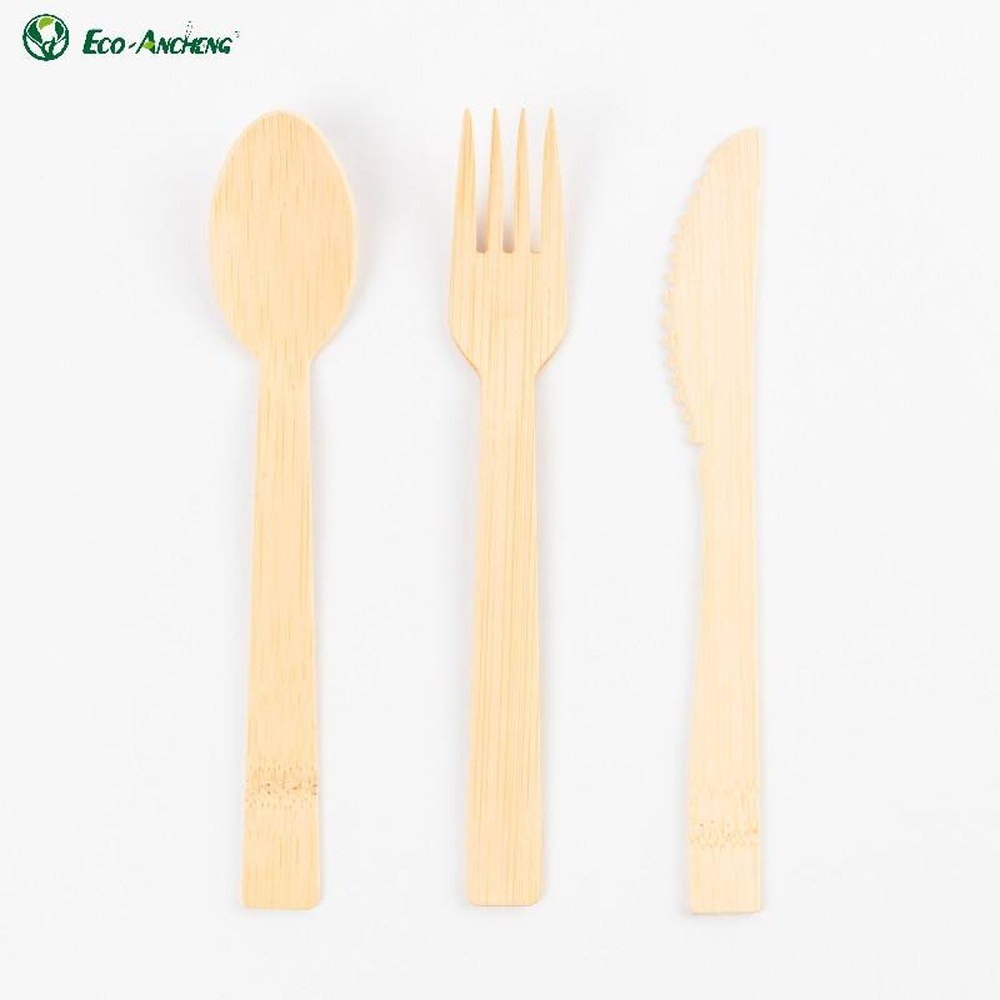
| Birch wood (FSC) | 140–160 mm | 3.5–5.0 g | no practical limit | 100,000 | $16–30 |
| Bagasse kits (fork+knife+spoon+napkin) | 160 mm | 18–24 g/set | 90 °C | 50,000 sets | $34–52 |
Directional pricing at MOQ, FOB Qingdao, unprinted; add roughly 8–15% for print on the handle or a paper wrap. Production runs 20–30 days, sea transit 25–35 days. Freight ran about $4,500–8,500 per 40 ft to the US West Coast in 2024–25, so quote it as its own line rather than burying it in unit price.
Fork tine spacing at 6–8 mm matters for pasta; too narrow and it reads as a dessert fork. Length tolerance of ±2 mm is normal — if your kit insert is cut to the millimetre, allow for it.
The trade-offs we tell buyers up front
Bagasse composite is the best all-round value for hot food, and the least elegant. The moulded surface has a visible fibre texture; diners notice. Birch is the opposite — light, natural-looking, heat-proof — but costs more per unit, and splinter control depends on polishing quality, which varies between mills. We reject roughly 2% of birch at incoming inspection for surface roughness.
CPLA gives you a familiar, plastic-like mouthfeel, and the narrowest temperature window. If your customer is an airline, a dessert brand or a cold-catering operation, CPLA is right. If they serve hot rice bowls, no certificate will fix that. Our wedding and event cutlery page shows how we mix formats for buffets where guests handle hot and cold dishes.
Checklist before you send an RFQ
Market and ban regime; article-level certificate with sample description page; tested weight and thickness; heat exposure; PFAS/TOF result. Send those and we answer with a spec sheet in two working days — the request a quote form takes a PDF attachment, usually faster than typing numbers into an email.
If you are still narrowing material, our contact page reaches the export desk; put your market and monthly volume in the subject line and you skip the first round of questions.
FAQ
Is a compostable fork allowed in the EU?
Not if it is plastic-based. Article 5 of EU 2019/904 bans single-use cutlery made wholly or partly from plastic, and CPLA counts as plastic. Fibre and wood utensils remain permitted, subject to food-contact rules.
Does EN 13432 on the resin cover the finished fork?
No. EN 13432 applies to the finished article, thickness and additives included. Compare the report’s sample description page with what you are buying.
Can CPLA cutlery go in the microwave?
No. Service temperature is around 55–60 °C in thin sections, and hotspots exceed that. Bagasse handles short contact at 90–100 °C.
Do wood utensils need FSC certification for the EU?
Not by law for the utensil itself, but EUDR due diligence and most retail buyers expect FSC or PEFC chain of custody, plus a hygiene statement covering milling, polishing and packing.


